When Decluttering Becomes Another Rule to Follow
Decluttering can become another rule to obey. Learn to spot when tidying turns into avoidance, perfectionism, or conflict, and choose a more useful next move.
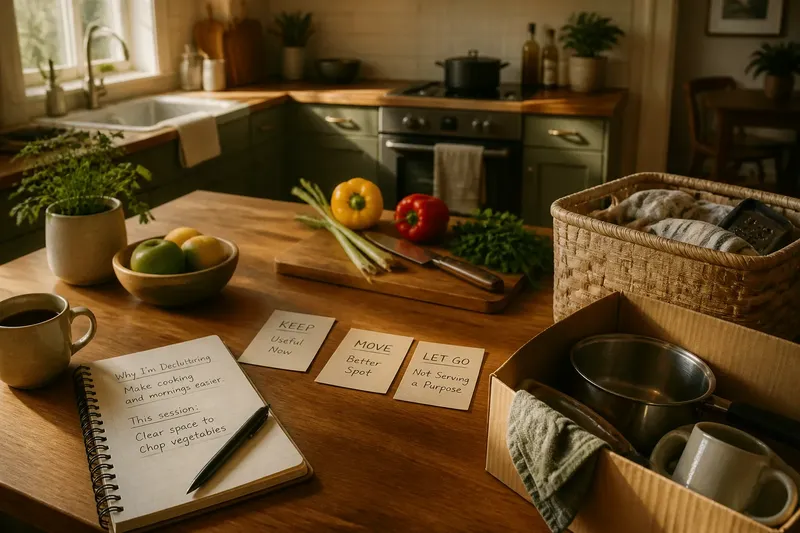
Does decluttering leave you wondering whether you should do more, even after the kitchen works and you can find what you need? Decluttering can become another rule to follow when every cleared surface invites a new test of discipline. The useful question is not how little you can own; it is whether sorting is solving the problem that brought you to it.
A clear counter can make breakfast easier. But if you keep clearing it because an empty surface feels like proof of virtue, the task has changed. Try treating decluttering like adjusting a lamp: the point is to improve the light where you need it, not to keep moving the lamp for its own sake.
Stop when tidying turns into a perfection test
You clear a counter, then notice the mail basket and decide it has to go, too. Soon, the goal is no longer having room to cook. It is making the kitchen look finished according to an image that may not suit the way you use it.
Name the specific task you want the space to support. “I can chop vegetables without moving anything” gives you a practical stopping point. “The counter looks minimal” does not; that standard can keep shifting.
Say you want room to prepare dinner but keep moving the fruit bowl because it interrupts the bare-counter look. If the bowl is the only obstacle, relocate it to a shelf within reach and check whether you can cook comfortably. If the work area is clear, stop there; if not, move only what still blocks the task.
Let needs, not ownership targets, guide the sort
A target for how many clothes, dishes, or tools to own is easy to count but cannot tell you what your household needs. A spare pan might help when another is being washed; an awkward pan that rarely leaves the cupboard might not be earning its space.
For each item, check its condition, the task it serves, and whether another item does that task as well. Then choose among keeping it, moving it to a more useful spot, or letting it go. If the category is still hard to judge, look at what makes an ordinary week easier rather than imposing a quota.
Imagine you cook most evenings and have several pans. One is especially useful for a dish you make often; another is hard to handle and seldom used. Keeping the first and donating the second leaves you with cookware that fits your routine, without requiring you to reach a particular count.
Keep sorting from becoming a trial of past choices
Finding an unused appliance or craft supplies can bring back regret about money, time, or plans. That feeling can turn a simple household decision into a judgment about who you used to be.
Separate “Was this a good purchase?” from “What should I do with it now?” The first question may not have a satisfying answer. For the second, check whether the item works, whether it suits a current need, and whether you can name a realistic use. If the answer is unclear and you feel pressured, set it aside and return when you can think calmly.
A sketchbook can stay because you enjoy drawing, even if you do not draw often. Craft supplies need not be kept as an obligation to become someone who uses them. Choose based on the role they have in your life now, not on a demand to justify the past.
Set shared-household rules around shared tasks
One person may want clear counters while another wants cooking tools close at hand. If either person starts moving or donating the other’s belongings without agreement, a disagreement about storage can become a dispute about respect.
Talk about the shared task rather than declaring someone’s possessions unnecessary. If the dining table needs to be clear for meals, agree on what moves and where it goes. Keep personal belongings under their owner’s control unless you have agreed otherwise.
A shared kitchen can have an open place for food preparation without requiring everyone to prefer bare counters. The goal is a workable arrangement, not a household-wide version of one person’s taste.
Look for the snag behind a repeatedly sorted drawer
If the same drawer keeps annoying you, more sorting may not address the cause. The problem could be a missing routine, an awkward layout, or several unrelated tasks being pushed into one place.
Notice what happens at the moment of frustration. What are you reaching for? What gets set down, and why? If the trouble is a missing home rather than too many belongings, try changing the arrangement before discarding anything.
For instance, if you keep searching for a charging cable, choose a place for it and return it there after use. If the cable becomes easy to find, the routine solved the snag; if not, reconsider where it is stored or whether another household member needs a separate one.
What questions help you decide whether to keep sorting?
Should I keep something I have not used lately?
Check whether it supports a recurring need, seasonal activity, or occasional responsibility. If it has a clear purpose, keep it accessible; if you cannot name a plausible role, consider setting it aside or letting it go.
Do duplicates always need to go?
No. Check whether a spare is needed while another item is in use or in another part of the home. If it makes a real task easier, keep it; if it adds clutter without serving a distinct purpose, consider releasing it.
What should I do when I cannot decide?
Place the item in a temporary holding spot if you have room, and choose a time to revisit it. If you still cannot decide then, consider what is making the choice difficult rather than letting the holding place become permanent storage.
How do I know when to stop decluttering?
Check whether the original problem has eased enough for you to use the space as intended. If the task has shifted to proving discipline or chasing emptiness, pause and return to the practical purpose.
Choose a useful boundary for the next sorting session
Before you begin, write down one friction point, such as blocked counter space or a hard-to-find item. During the session, check each proposed change against that problem. If it helps, keep the change; if it does not, stop adding new targets and try a different solution.
This gives decluttering a boundary: it serves a task rather than expanding into a judgment about your habits. The next time tidying starts to feel like a demand, return to the original snag and ask what small change would make that part of the day easier. If no object needs to leave for that change to happen, you can be done for now.